

because I remember II
To Tykocin and Treblinka: Further reflections on Day 2 of the March of the Living

Author’s notes: You can find the first instalment of this series here.
Recently I was doing research on my bubbe’s family history and heard testimony regarding her Aunt’s family, a story I knew but not in detail. My bubbe had always talked about how close her mother had been with her sister, who had lived in France prior to the Holocaust. How worried she had been when the letters stopped. Listening to this testimony I learned that my bubbe’s uncle received 2 postcards from his own family in 1942, from the Warsaw ghetto. I learned that there was a brief correspondence between them, between Poland and France, before contact was lost — on the eve of the mass deportations from the Warsaw Ghetto to Treblinka. This has put revisiting this particular day into a new perspective for me.
After watching the sunrise in Poland out of the hotel window, our first stop on the second day of the trip was another 2 hour drive away; a small village called Tykocin. It is in what is now called the Podloskie Voivodeship, in North-Eastern Poland near the borders of Lithuania and Belarus. From research I’ve done recently, this area is closer to where some of my family lived – North of Lublin, in a town called Radzyń Podlaski by the eastern, historically ever-shifting borders. Instead of sitting on my own on the bus ride that morning, I sat with Esther, one of the Holocaust survivors accompanying the trip. She has since told me that she felt protective of me when she saw I wasn’t in the back of the bus with a group of friends. We walked off the bus together and moved forward with the group. I remember walking through Tykocin to almost pure silence. For a town with just under 2,000 inhabitants in the least populated area of Poland, it is likely a regular occurrence to be alone with your thoughts, but I wasn’t used to such silence. We walked through the backyards of homes and in between woodsheds, and hardly anyone spoke a word. We were walking to the synagogue, which was a shell of itself and no longer in use.
On Monday the 25th of August, 1941, all of the Jews in Tykocin who were not already sent to the Bialystok Ghetto were rounded up by German Nazi forces and Polish police, marched or driven to nearby Łopuchowo Forest, and shot into mass graves by German Einsatzkommando. In the blink of an eye, an entire community was gone. Hundreds of years of a rich and vibrant history. To this day, no Jews live in Tykocin.
When I looked on google maps to see what the synagogue looks like now, I was confronted with a stark difference. Clicking on the street in front, I saw new windows in dark red wood, and pepto-bismol pink and blue paint coating the exterior. In the moment frozen in time and forever imprinted on the internet, there are multiple cars parked out front and several people, mostly kids, standing in the synagogue’s open doors. From the timestamp in the top left corner I can see that it was taken in June of 2023. Flowers bloom in standing baskets around the small parking lot, and several buildings on the street corner appear to have been repainted. Life goes on.
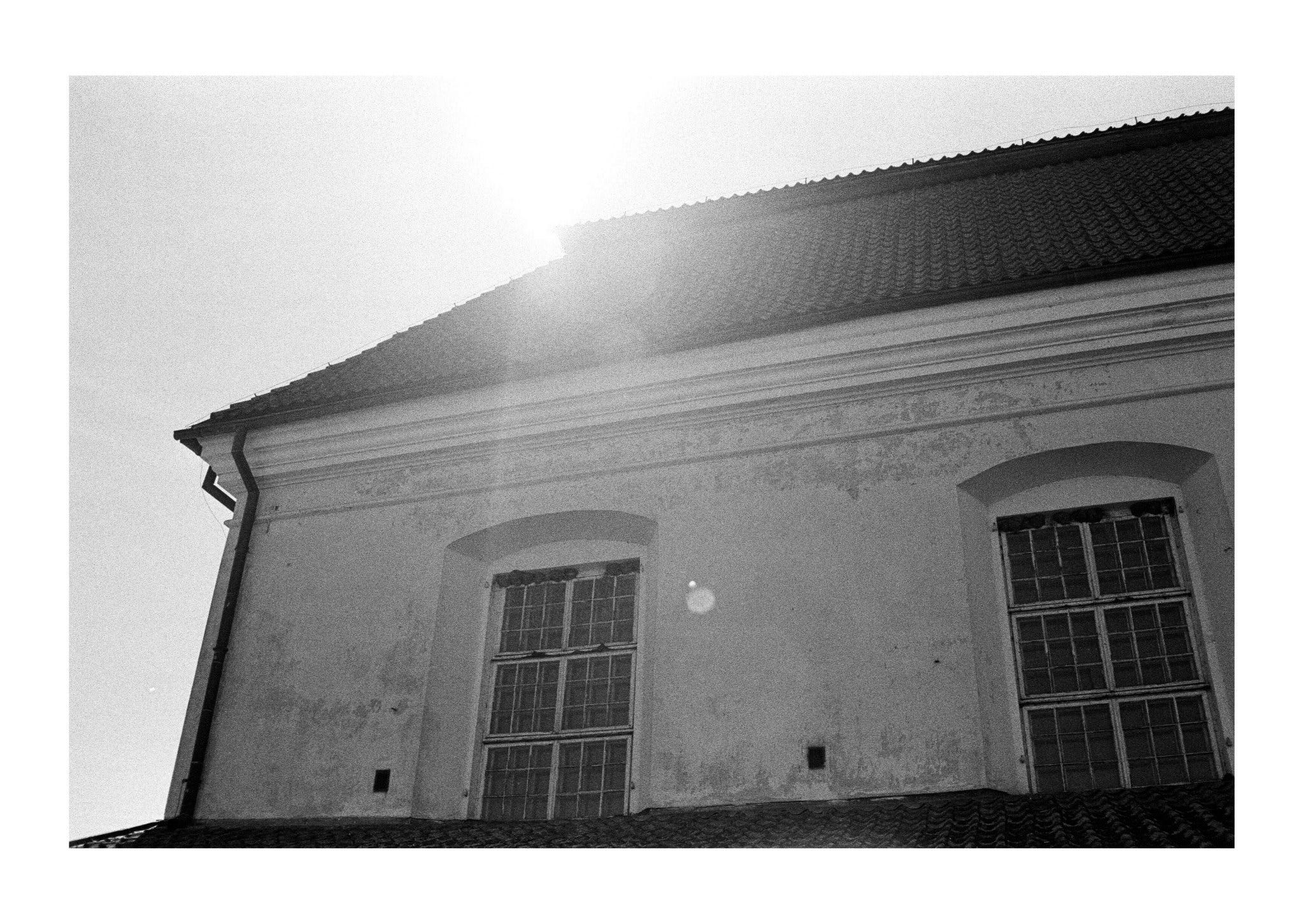
I clicked to a spot around the corner to see the side of the synagogue, and to my surprise that one click took me back 10 years. In July 2013, the google maps car had taken a route around the synagogue that they refrained from doing in 2023, so the side view is almost exactly as I remember it. Near empty streets, peeling white paint with large chunks coming off by the grass characterise the building. There are no planters in front and the grass is patchy and trodden. It looks like all the other buildings on the surrounding streets, nothing special. I clicked again into 2023 to take another look, and had to flip through my personal photos of the day to confirm what I thought I saw — the same old man I took a picture of in 2014 was there, on google in 2023, in the same spot. Carved figures piled high on a table in front of him and woodcuts depicting Jewish men and shtetl life placed on the windowsills, I remember wishing I’d said something to him, though I’m sure my not speaking Polish would have been a barrier. If you zoom in past a car in the lot, you can just see him, right next to the front door, still there and still setting up shop. I don’t know what his story is, but I wish I did.


The synagogue was completed in 1642 and desecrated during World War II. When we visited in 2014, the exterior walls were as seen in the above photo on the right —white paint that was old, peeling and chipped away. The windows seemed to be original at the time, with some broken and warped, some painted over. I imagined faces peering out of them from the safety of the synagogue walls, looking out at a town and country and neighbours changing and growing more and more hostile each day. Inside, I remember still feeling the sanctity of the space, even after what I thought was so much time had passed. In reality, not much time had passed at all. If all the Jews in Tykocin had not been murdered on that warm August Monday, there would still be people alive today who remembered what it was like to worship here.
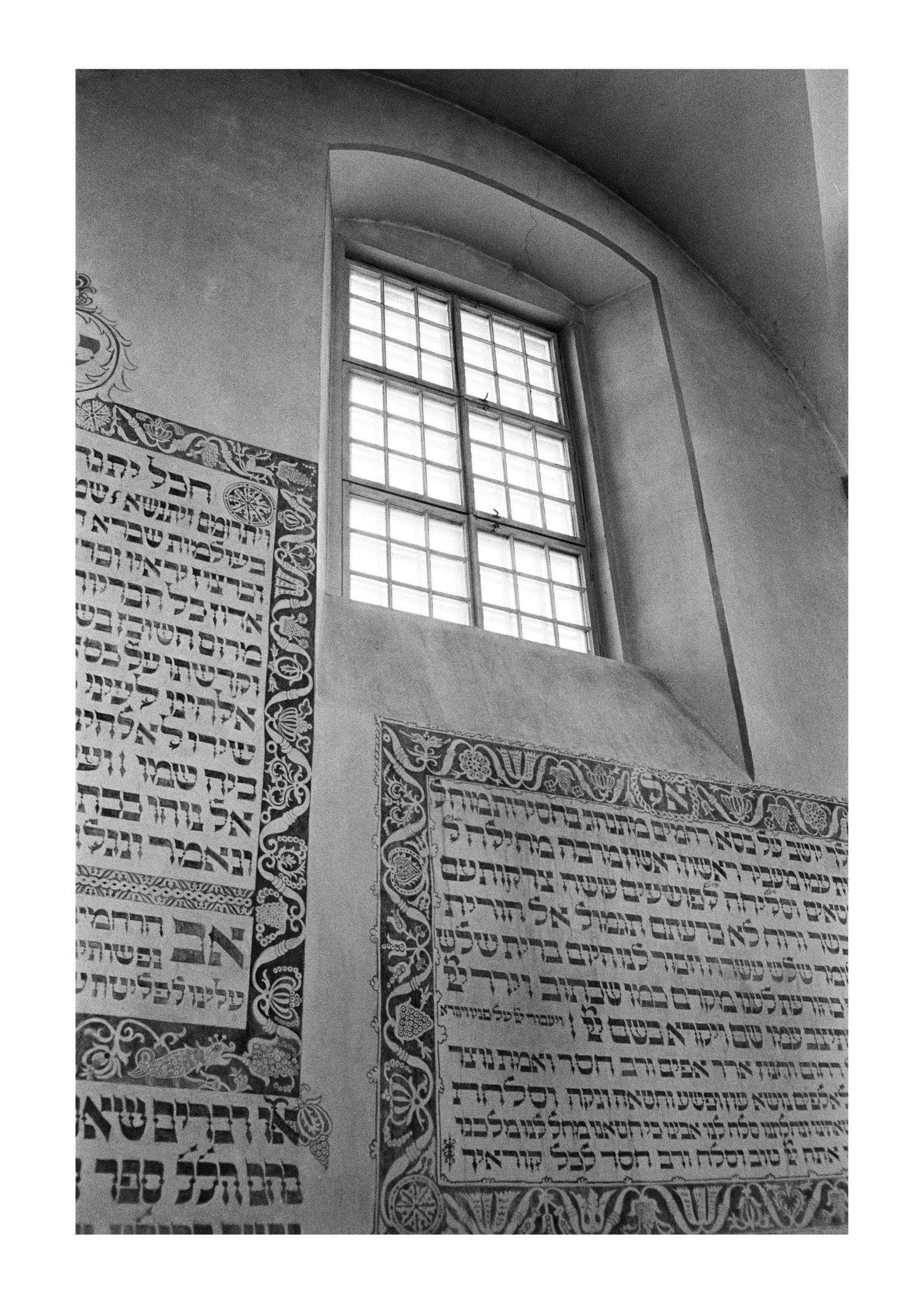
Walking in and feeling that sanctity was the first time on the trip where I didn’t feel drained or exhausted. I got excited seeing the frescoes of faded animals and the beautiful Hebrew lettering adorning the walls. The bimah was in the middle of the room, made out of rich, commanding wood. We were led in song and prayer by a Rabbi who was in our group. We sang and danced (At the time, I was begrudgingly pulled into the horah by Esther, but I’m glad she did) and briefly left the horrors of the trip outside of the walls. If I was standing there today, I would say the shema and probably cry at how beautiful the light is coming through the thick panes of glass in the windows. Now, I remember thinking, it is up to us to remember what it feels to be here, to be alive, and to be Jewish.
After Tykocin, we walked to Łopuchowo Forest. Again, we walked along the road and then through the trees in silence until we made our way to the memorial site. We sat on a small hill, if you could call it that at all, in the damp grass and listened to more details about the people of Tykocin. The memorial site in the forest is small, with an old communist era Polish plaque that doesn’t mention Jews at all, followed by three more put up by Jews to remember our own. A reminder that even when faced with clear facts, we have historically had only each other to rely on. As we left the forest and made our way back to the bus, I trailed in the back of the group. I walked near Esther and let my hand run along the bark of every tree. I imagined a child seventy years earlier doing the same, except it was probably the last thing that child ever did. I was getting on a bus with survivors and kids draped in Israeli flags, and we would be driving away to the rest of our lives.
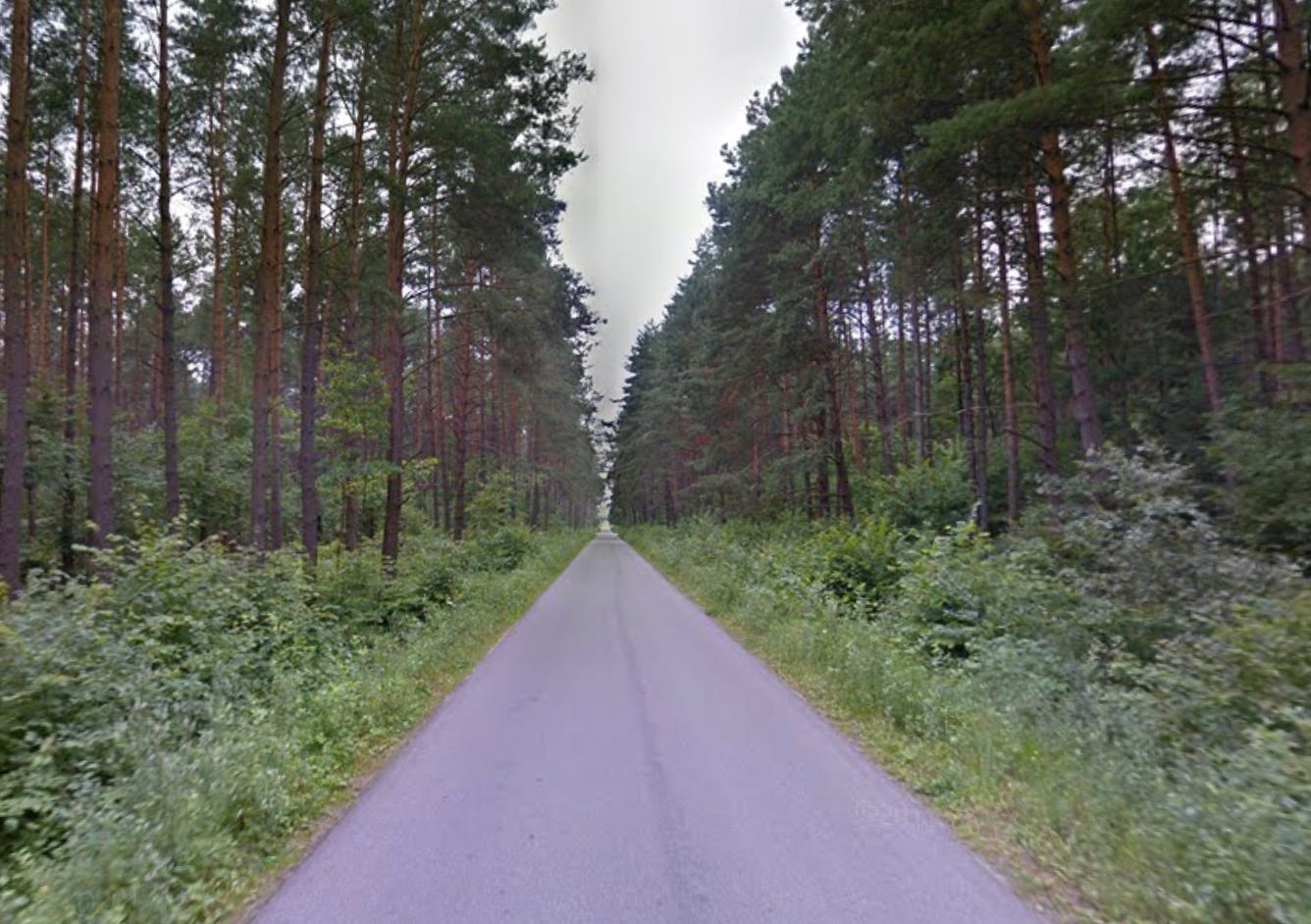
Almost exactly halfway back to Warsaw, an hour out of Tykocin, you make a left turn in the town of Ostrów Mazowiecka. Once out of the town, it’s a straight shot to your destination, driving on a narrow road with tall pine trees on either side. For about twenty minutes, I watched the light flicker between the tree trunks and stretch on the soft green earth, moving along with the bus. Occasionally the trees would recede and the view would open up to fields. I remember seeing a farmer walking through a field of green and gold. We passed a few towns, each one basically a single intersection with a few small houses in a cluster. We drove over a river and through terrain that seemed familiar even in its unfamiliarity to me. I had never been here before and every time I looked out at the land, it felt strange to think that so many of my ancestors would have known it so well. I was surprised when we made a sharp right off the highway; I’d been staring out the window for the whole drive, and there had been no sign or indication that we were arriving. Yet as we turned in, I saw a small sign posted up in the trees — ‘MUZEUM TREBLINKA’.
We were at the site of Treblinka II, built after Sobibor and Belzec as the third and final killing centre in Operation Reinhard1. It was purposefully built deep into the woods, branches woven into the barbed wire to try and keep the evil contained. Today, there is nothing that remains of the camp — it was destroyed by the Germans before it could be liberated, all of it. They destroyed the 2.5 storey watchtowers, and the area they called ‘the chute’ where prisoners were forced to run naked, after being forced to strip down, towards the chambers that would fill with carbon monoxide and kill them.
Treblinka II operated for just under a year and in that time managed to be the murder site for almost 1 million Jews from all over Poland. A small Sonderkommando unit of Jewish prisoners deemed fit for work were forced to clean the gas chambers, dig the pits, and bury the bodies of their murdered tribesmen — of their brothers and sisters, mothers and fathers, wives and children. It is a place of pure evil and pain. It is somewhere I think everyone should go and see.
The bus stopped right inside the sign and we piled out. There was no building there, no entry gate or person directing you. We just walked through the woods, following an old stone path I couldn’t help but think of in terms of who else had walked it in the past. Around a corner the woods opened up slightly and the first of the stone monuments appeared. Dark and moss covered and bearing death.


After these stones, the air felt suddenly heavier. The path narrowed and the trees closed in, and now on one side of the path, as far as I could see, were rectangular stone markers to denote where the railroad tracks had been. They went on and on, deeper into the woods — and we followed.
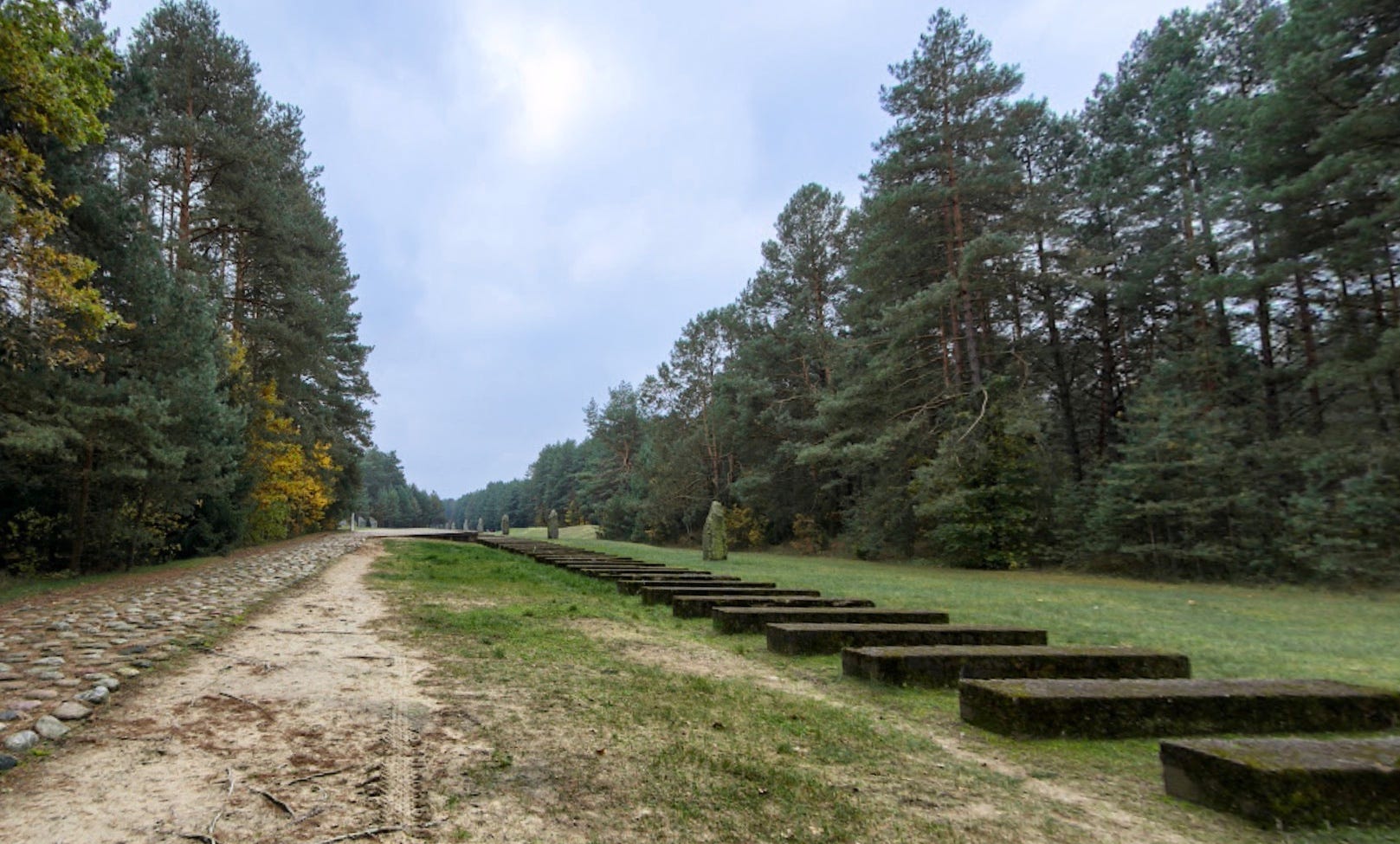
It felt like the walk from the highway took hours, though I’m sure it didn’t in reality. It was a clear, sunny day, but it didn’t feel like it was. I thought of the gravestones piled on top of and next to each other that we’d seen the day before, how the almost million buried here would never even have a gravestone to be broken. I tried to think of all the stones we walked on and the stone markers as the kinds of stones we place on top of graves, a marker of visitation and remembrance. It made me feel better until we came to the end of the railroad markers and turned to the left.
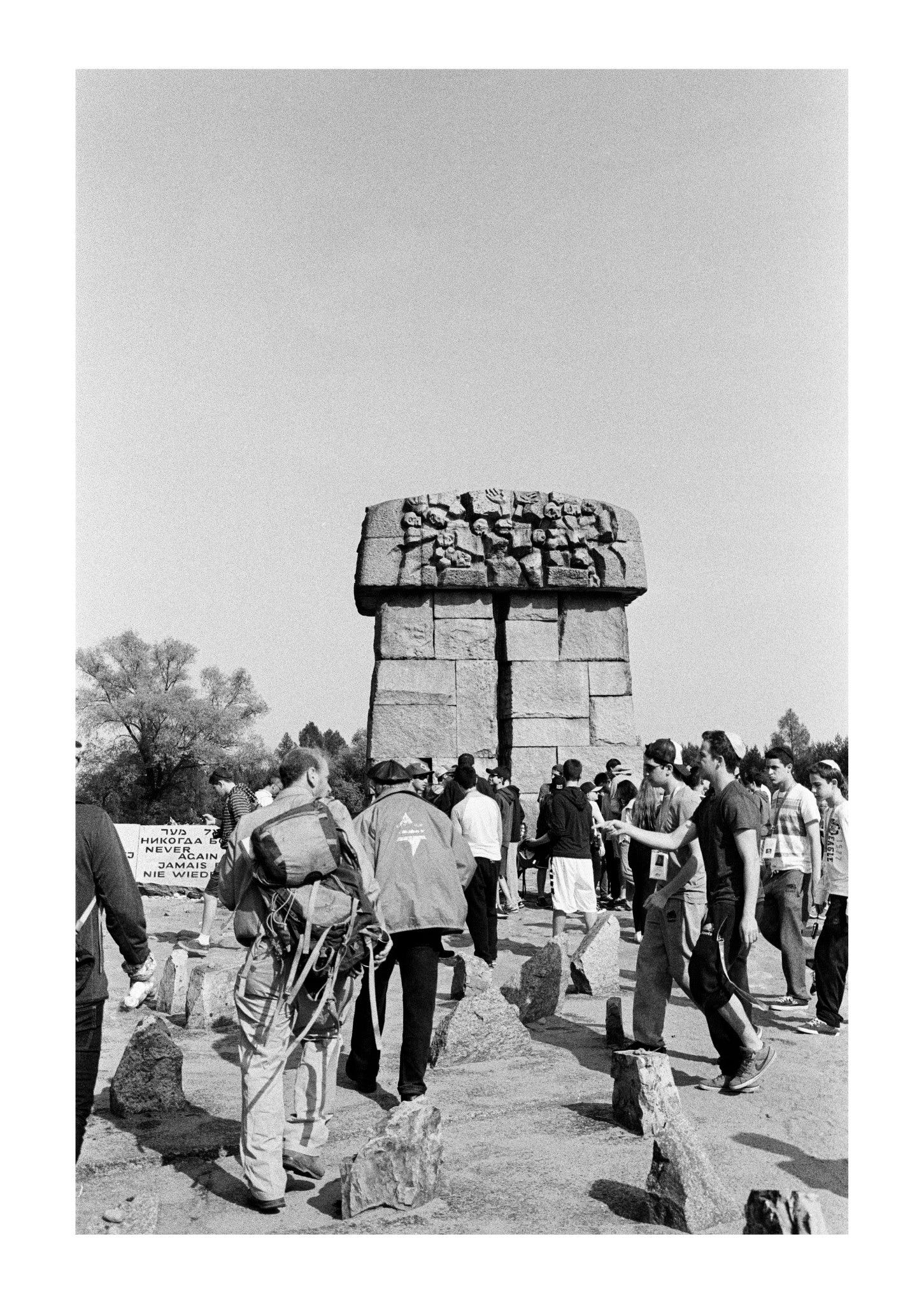
I remember breathing sharply and then feeling like all the air around me had disappeared. The stone path led straight to a large granite structure that itself was surrounded by a circle of hundreds of jagged stones. I felt like it would crush me just from walking up to it. The granite structure looked to me like the Kotel in Jerusalem, but instead of tiny folded prayers in its cracks, carved out limbs and heads floated at the top, and it was cracked in two down the middle.
All of the busses had stopped here and a horde of teenagers and chaperones poured into this hollow and broken place. I walked through the stones and felt the jagged edges on my fingers. Some of the stones surrounding the large monument had names of towns written on them, places from which Jews were deported to be murdered here. Ashes and bodies still feed the ground I stood on. I circled the monument between the stones, amidst the chaos of our arrival. Behind the granite structure was a bit quieter, as people hadn’t gotten there yet. I remember that there is a menorah carved into the back of the stone.
Looking further into the field I noticed a dark rectangle on the ground, and even further still, more jagged stones stuck into the earth. The rectangle was black and looked as if some great giant had scooped out and scorched the earth there. I wanted to walk over to it, to drop to my knees in the earth and touch it and see what it felt like. See if my hand came up burnt. Behind me and in part of my mind that felt a million miles away, I heard someone calling for everyone to huddle in, so I turned back.
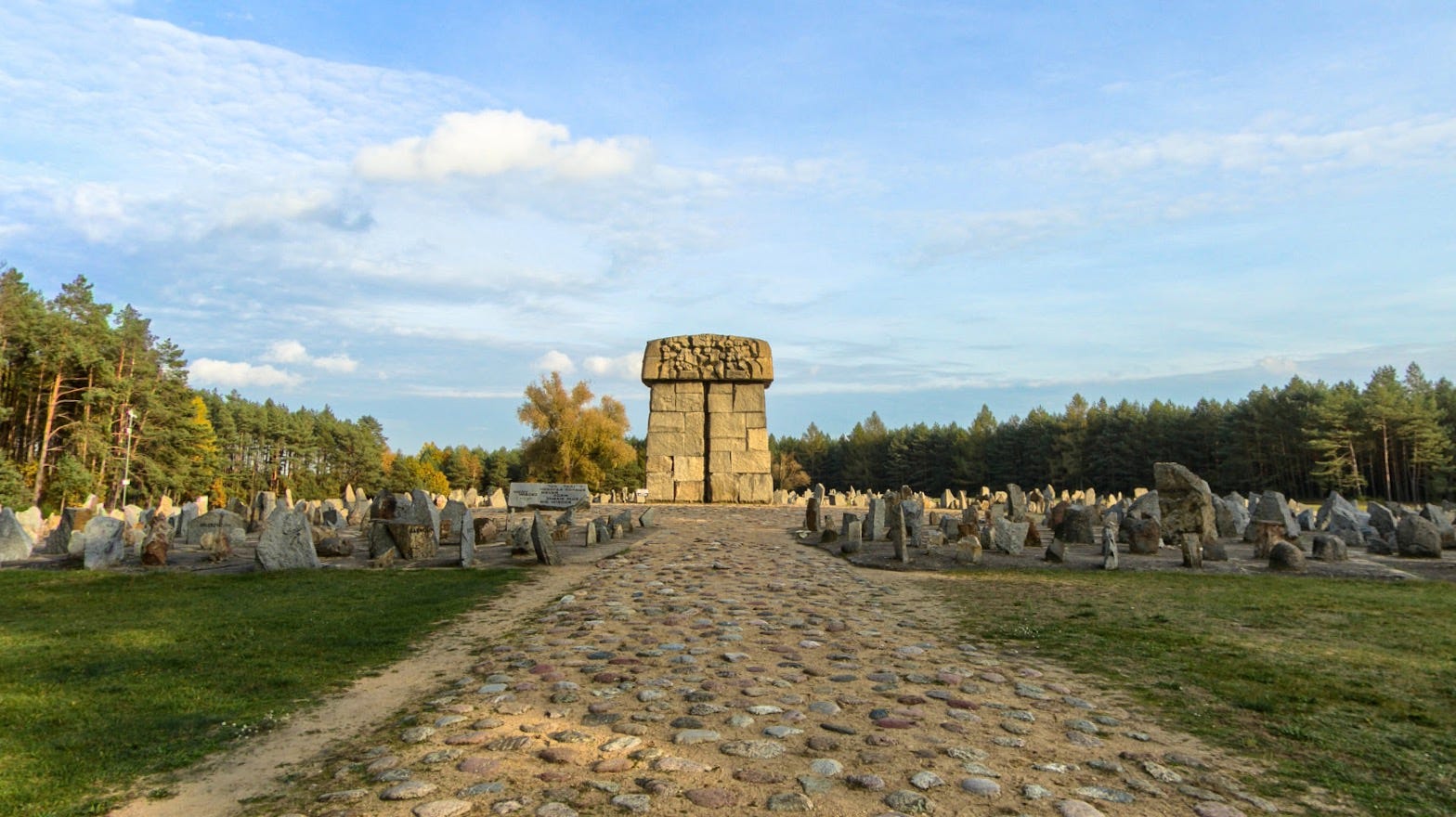
We came together in front of the monument, circling the Rabbi who was now standing in front of the granite and behind a quickly set up microphone and amp setup. I remember the Rabbi speaking about faith. Someone talked about the memorial itself, and I learned that the black rectangle on the ground in the field was made up of black basalt stone, placed into a hollowed out strip of earth to memorialise the crematoria. I pulled my jacket tighter around me even though it was still bright and sunny out. I also distinctly remember hearing Nate speak for what I think was the first time on the trip (outside of small pep talks on the bus). Nate was on our bus along with Esther; he is also a Holocaust survivor, and he is also a member of my family. I’d seen and hugged him at seders for as long as I could remember, but seeing him here, and listening to him here, was different. He stood next to a stone slab that reads ‘NEVER AGAIN’ in seven different languages. As he spoke I looked up at the very top of the monument, to the carved out hand reaching for the sky. I looked at the cracks between the granite slabs and saw, on the narrow edges and wherever possible, small pebbles. Some stacked on top of others, some stuffed and resting perfectly in a corner of rock just like a folded prayer at the western wall. Despite the hundreds of thousands of names we will never know, despite the fates that will remain uncertain forever, we still place stones. We still do our best to remember.
Operation Reinhard was the German plan to exterminate all of the Jews in Nazi-occupied Poland.